
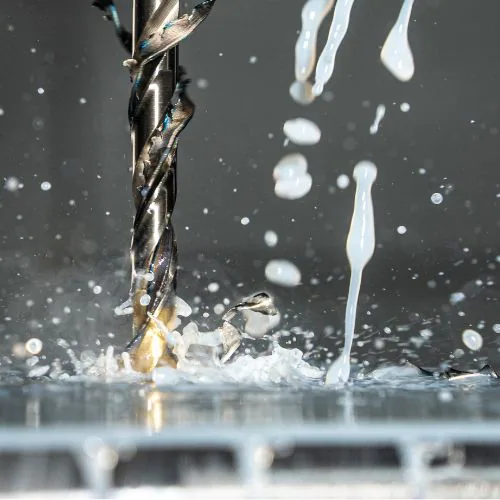
When each coolant family is typically considered
Semi-synthetic coolants are often considered when an operation needs a balance of lubricity, cooling, and broad machining use. Synthetic coolants are often considered when heat removal, grinding performance, cleanliness, or low residue is a priority. These are starting points for product screening, not universal selection rules.
| Coolant family | Common reasons to evaluate it | What still requires confirmation |
|---|---|---|
| Semi-synthetic | A balance of cooling and lubricity, mixed machining duties, or a preference for a fluid with an oil component. | Process severity, materials, water quality, residue, foam, machine compatibility, and the specific product's oil and additive system. |
| Synthetic | Heat removal, grinding, visibility, cleanliness, or low-residue operation, when the selected formulation supports the process. | Required lubricity, materials, water quality, foam, corrosion control, machine compatibility, and the specific product's chemical system. |
If both families appear viable, compare supplier-approved products through a controlled trial using the same parts, tools, water, concentration, condition checks, and acceptance criteria.
What semi-synthetic and synthetic mean
These names identify broad fluid families, not a fixed recipe or guaranteed level of performance. Formulations vary by manufacturer and product, so the product data sheet and fluid supplier remain the authority for mixing, concentration, compatibility, and safe use.
Semi-synthetic coolant
A semi-synthetic concentrate commonly combines oil with synthetic lubricity, emulsifier, corrosion-control, and other performance additives. When mixed with water, it typically forms a fine dispersion or microemulsion. The amount and type of oil vary, which means two products carrying the same family name may behave differently in the same operation.
Synthetic coolant
A synthetic coolant is generally formulated without mineral oil. Lubricity, corrosion control, detergency, and biological stability come from the selected chemical system. Some synthetics form clear solutions, while others may appear translucent or opaque. Appearance alone does not establish whether the fluid will perform in a particular machining process.
Ask for the product's technical data sheet and safety data sheet rather than selecting by the words semi-synthetic or synthetic alone. The formulation, recommended concentration range, refractometer factor, material compatibility, and water-quality limits are product specific.
How the two coolant families compare
Both families use water as the working fluid after mixing and can be formulated for machining or grinding. Their differences are best treated as selection tendencies that must be confirmed for the exact product.
| Selection factor | Semi-synthetic coolant | Synthetic coolant |
|---|---|---|
| General formulation | Commonly contains oil plus synthetic and emulsifying components. | Generally formulated without mineral oil, using chemical lubricity and performance additives. |
| Operating balance | Often selected when a balance of lubricity, cooling, and broad machining use is required. | Often selected where heat removal, cleanliness, grinding performance, or low residue is important. |
| Lubricity | The oil phase may support boundary lubrication, but performance depends on the complete additive package. | Lubricity is supplied by the formulation. Do not assume that oil-free means unsuitable for demanding work. |
| Visibility and residue | May be translucent or opaque and may leave more oily residue, depending on the product and concentration. | Some products run clearer and cleaner, but clarity and residue behavior are formulation dependent. |
| Water sensitivity | Water hardness, dissolved minerals, chlorides, conductivity, and make-up water can affect foam, stability, corrosion control, and residue in either family. | |
| Condition control | Both require correct mixing, concentration monitoring, contamination control, and corrective action based on supplier limits. | |
| Purchase and operating cost | Concentrate price is only one input. Compare usable mix, consumption, tool and part results, maintenance labor, filtration requirements, change-outs, and waste handling. | |
No row in this table establishes a universal winner. A well-matched synthetic may outperform a poorly matched semi-synthetic in an operation that appears to favor oil content, and the reverse can also be true.
Select the fluid around the operation
Start with the cutting process and the result the operation must hold. A fluid change affects the complete system, including the workpiece, tooling, machine materials, pumps, seals, filtration, water supply, operator practices, and downstream cleaning.
Process and material
- Machining severity: identify the operation, speed, feed, tool geometry, contact pressure, and whether cooling or boundary lubrication is limiting performance.
- Workpiece and tool materials: confirm staining, corrosion, residue, and additive compatibility for every material that contacts the fluid.
- Part requirements: define the required finish, dimensional control, cleanliness, and downstream coating, washing, or assembly steps.
- Machine requirements: review the machine builder's guidance for fluid type, seals, paint, filtration, and delivery system.
Water and shop conditions
Make-up water is part of the coolant formulation. Hardness and dissolved minerals can affect emulsion stability, foam, corrosion protection, deposits, and concentrate use. Temperature, evaporation, carry-off, tramp oil, and incoming solids also change fluid condition after the initial mix.
Operator and maintenance requirements
Consider how the fluid will be mixed, measured, adjusted, filtered, and documented. A product that performs well in a controlled trial may still be a poor plant fit if the required monitoring, water treatment, cleaning, or contamination control cannot be maintained consistently.
- Define the failure or performance gap before comparing products.
- Review supplier-approved concentration and mixing procedures.
- Confirm material, machine, seal, paint, and filtration compatibility.
- Run a controlled trial with agreed part, tool, fluid, and maintenance checks.
- Compare total operating results rather than concentrate price alone.
EdjeTech's metalworking fluids overview outlines the fluid categories and equipment available for an integrated fluid-management program.
Maintenance implications for either coolant family
Both families require correct mixing, supplier-approved concentration checks, contamination control, and action based on the specific product's limits. Use the fluid supplier's method and refractometer factor, because tramp oil, dissolved contamination, and fluid aging can affect interpretation.
Machining fines, grinding swarf, way oil, hydraulic oil, and other contaminants can interfere with either family. Filtration and tramp-oil separation may support fluid condition when the equipment is compatible with the coolant and matched to the particle load, oil state, and flow.
Physical treatment removes targeted contamination. It does not restore depleted additives, repair an incompatible mix, or prove that degraded fluid remains suitable for service. The CNC coolant management guide covers condition monitoring, filtration, recycling boundaries, warning signs, and corrective action in more detail.
A practical decision process
- Describe the current operation. Record the process, materials, tools, machine, fluid-delivery method, filtration, water source, concentration, and operating conditions.
- Define the reason for change. Separate tool, finish, corrosion, foam, odor, residue, carry-off, maintenance, and cost concerns instead of treating them as one coolant problem.
- Screen compatible products. Have the fluid supplier confirm material, machine, water, process, and equipment compatibility.
- Establish trial criteria. Agree on the parts, tools, finish checks, fluid measurements, maintenance inputs, and stop conditions before changing production equipment.
- Evaluate the complete program. Include mix consumption, labor, filtration, cleaning, tool and part results, change-outs, and waste handling.
A semi-synthetic coolant is not automatically the safer middle choice, and a synthetic is not automatically cleaner, longer lasting, or easier to recycle. The defensible selection is the product that meets the verified process requirements and can be maintained under the site's actual conditions.