
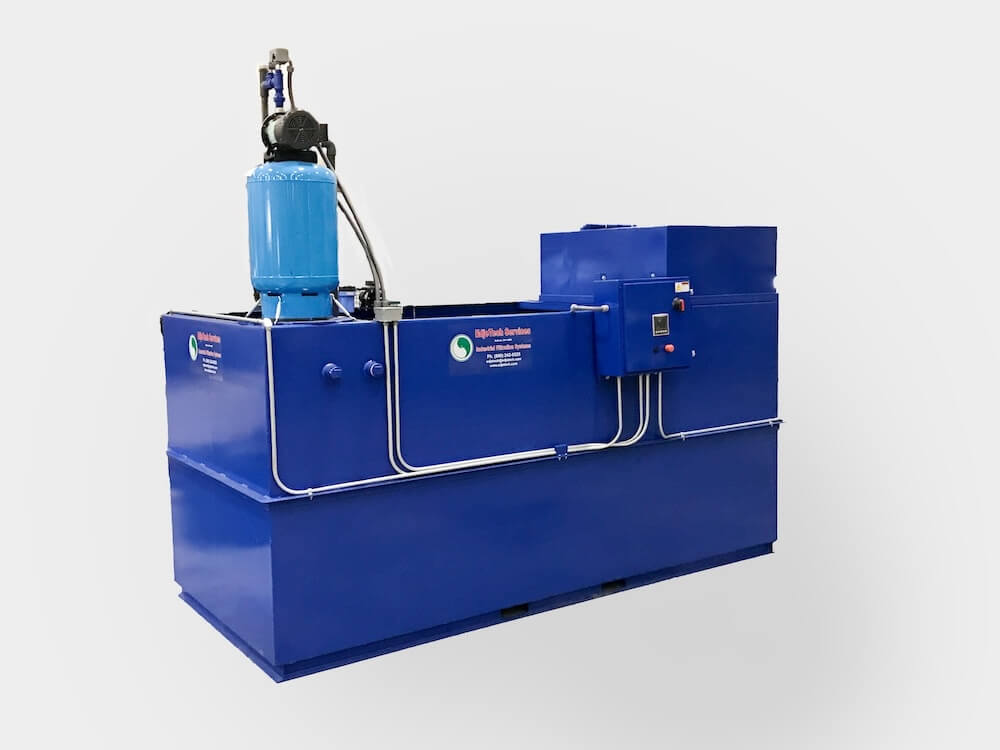
Coolant recycling and filtration for automotive and EV component manufacturing.
Recycling and filtration for the metalworking coolant that machines automotive and EV components: engine blocks, transmission parts, battery housings, busbars, and motor laminations.
- 99.75%
- tramp oil & particulate removed by C.R.O.S.S., by volume
- up to85%
- reduction in new fluid purchases with C.R.O.S.S.
- up to90%
- reduction in waste-disposal cost with C.R.O.S.S.
- 40+ yrs
- fluid-management engineering experience
Configure equipment for the process and metal mix
Combustion-engine, EV, and tube-mill operations produce different contaminant loads and require different coolant-management systems.
- Internal combustion
Engine, driveline & tube
Engine blocks, transmission and drivetrain, brake and ride-control, structural and exhaust tube.Ferrous chip load, cast iron fines, and tramp oil in water-based coolant, multiplied by automotive throughput on lines that run continuously.
- High-volume component plantSized by coolant volume and throughput
- C.R.O.S.S. · engineer-sized
- Tier-2 / tier-3 shopComponent machining cell
- C.R.O.S.S. · shop-wide recycling
- Tube-mill operationExhaust, structural, ride-control
- TMCRS · mill scale
- Electric vehicle
EV battery & motor
Battery housings (aluminum), busbars (copper), motor laminations (silicon steel).Battery and motor machining produces mixed ferrous and non-ferrous particulate. Aluminum housings, copper busbars, and silicon-steel laminations require filtration stages matched to the metal mix and downstream cleanliness requirements.
- Ferrous shareLamination fines
- Magnet · 98%
- Aluminum & copperNon-ferrous fines
- Paper bed
- Coolant recoveryRecycling with C.R.O.S.S.
- 2–25 GPM
Match the system to the operation
Automotive component machining uses C.R.O.S.S. for central coolant recycling. Automotive tube-mill lines use TMCRS for real-time mill-coolant filtration.
- Component cells & EV machining
C.R.O.S.S.
2–25 GPM · 120–1,500 GPHCentral, batch, or hybrid deployment supports shop-wide coolant recycling for component machining facilities. Final sizing follows coolant volume and required throughput. Estimate simple payback from quoted investment and current fluid, disposal, labor, and maintenance costs.
See C.R.O.S.S. → - Tube & steel mill lines
TMCRS
Engineered to mill flowPermanently integrated for real-time filtration at the flow rate required by the mill, with recovered oil at 2% or less water. Exhaust, structural, and ride-control tube lines.
See TMCRS → - Mixed facilities
Application review
Machining + tube-mill operationsFacilities with both component machining and tube-mill lines may require separate systems sized for each operating process.
Request a multi-process application review →
Coolant management for automotive production
Select recycling, filtration, separation, and sump-cleaning equipment by operation, fluid type, contaminant load, and required flow.
| Equipment | Application | More information |
|---|---|---|
| C.R.O.S.S.2–25 GPM | Recycling for component cells and EV battery machining, with portable, piped clean-coolant, or hybrid transfer. Removes 99.75% of tramp oil and particulate by volume. | View → |
| TMCRSEngineered to mill flow | Real-time coolant recovery for automotive tube-mill lines. Systems have processed up to 990 GPM and can scale to 1,600 GPM or more, with recovered oil at 2% or less water. | View → |
| Magnetic separator98% ferrous | Continuous removal of ferrous fines, including silicon-steel lamination swarf, with no filter media to replace. | View → |
| Paper bed filter10–60 µm | Media filtration for aluminum, copper, abrasive grit, and other non-ferrous particulate, used independently or with C.R.O.S.S. | View → |
| Green Machine55–70 GPM | Portable sump cleaning for component-machining operations. A typical manual cleaning that can require about four hours can be completed in approximately 15 minutes. | View → |
| T.O.S.S.2–50 GPM | Autonomous tramp-oil control for water-based machining, stamping, roll-forming, and parts-washer fluids. | View → |
Standardize equipment, process control, and ownership support
A common equipment specification can simplify training, replacement parts, maintenance planning, and performance expectations across multiple facilities.
Process-control requirements may include defined coolant concentration, contamination limits, inspection records, and maintenance controls. C.R.O.S.S. mixes concentrate and water at the required concentration and operates at 99% or greater uptime to support consistent coolant management.
- up to 85%
- Potential reduction in new coolant purchases with C.R.O.S.S.
- up to 90%
- Potential reduction in waste-disposal cost with C.R.O.S.S.
- Your inputs
- Simple payback based on quoted investment and current fluid, disposal, labor, and maintenance costs.
Automotive coolant-management considerations
- 01
Is this for vehicle coolant or machining coolant?
Machining coolant. EdjeTech filters and recycles the metalworking fluid used while cutting automotive and EV components. The thermal-management coolant that circulates in a vehicle or a battery pack is a different industry and not what these systems handle.
- 02
Can one system handle aluminum, copper, and steel on the same line?
Magnetic separation removes ferrous fines at 98%, while aluminum and copper require media filtration such as a paper bed. Mixed-metal applications may use magnetic separation ahead of media filtration. An engineer determines whether the filtration is standalone or integrated with the broader coolant-recycling arrangement.
Review paper-bed filtration → - 03
How is a system sized for a tier-2 or tier-3 component shop?
C.R.O.S.S. serves component-machining facilities that need shop-wide coolant recycling. Models process approximately 2 to 25 GPM and are sized by coolant volume, required throughput, contaminant load, service schedule, and facility layout. Automotive tube mills use TMCRS.
Review C.R.O.S.S. sizing → - 04
Can equipment be standardized across multiple plants?
Yes. EdjeTech can evaluate a common equipment specification, replacement-parts plan, and support approach while accounting for differences in process, coolant, contaminant load, and required flow at each facility.
Estimate potential savings →
Plan coolant treatment around your production line
Keep cleaner coolant reaching your machining operations while reducing fluid waste across your production line.
- Savings and payback
Savings calculator
Estimate potential coolant and disposal savings.
Estimate potential savings → - Equipment guidance
Talk to an engineer
Plan treatment for different metals and flows across your line.
Talk to an engineer → - Multi-plant planning
Standardization review
Evaluate common equipment and support requirements across multiple facilities.
Talk to an engineer → - Machine-shop equipment
C.R.O.S.S. or T.O.S.S.
Compare facility-level recovery with fixed and portable reservoir treatment.
Compare equipment →