
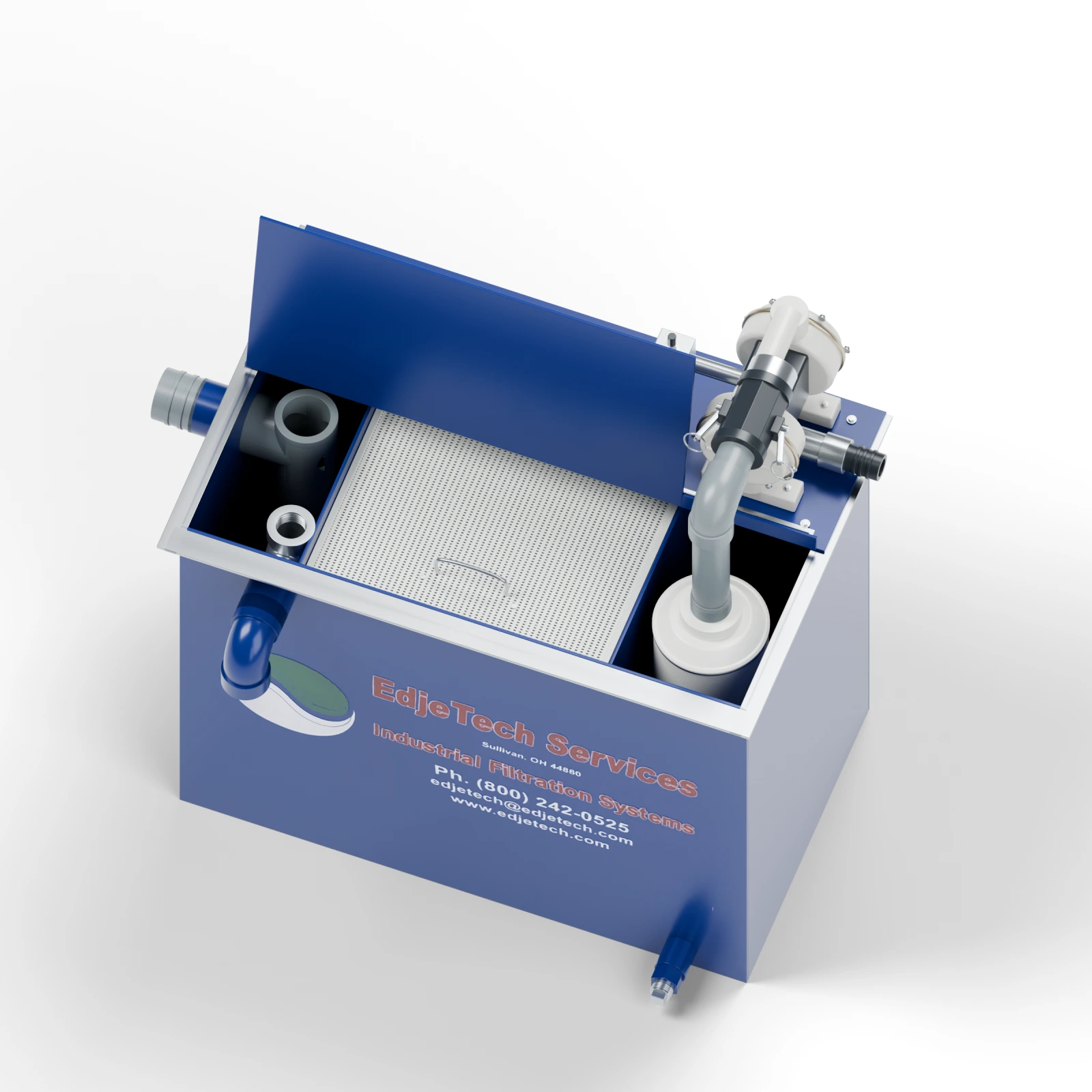
What a tramp-oil coalescer does
A coalescer treats oil-rich coolant collected from a sump, reservoir, pit, or parts washer. It is intended for tramp oil that can separate from the coolant. A stable chemical emulsion requires a different treatment approach.
How coalescing supports surface pickup
A surface pickup collects oil already floating at the top of the coolant. It can also draw in smaller oil droplets that have been mixed through the fluid by circulation or machining. A coalescer gives those droplets a controlled place to combine and rise before the treated coolant returns to the reservoir.
Actual performance depends on fluid chemistry, incoming oils, solids, temperature, flow, residence time, and separator configuration. The coolant must release the unwanted oil so it can form a separate layer.
How the coalescing process works
The sequence below shows how our T.O.S.S. system collects, separates, and returns coolant. Other coalescer designs may use a different flow path.
- Collect oil-rich coolant. A surface pickup draws fluid carrying free and mechanically dispersed tramp oil from the sump, reservoir, pit, or parts washer.
- Remove interfering solids. Depending on the configuration, the fluid passes through a prefilter, bag filter, or both before reaching the coalescing media.
- Move the fluid gently. The specified pump and flow arrangement limit unnecessary droplet breakup and carry the fluid into the separator.
- Combine droplets and allow them to rise. The media increases opportunities for droplets to contact its surfaces and one another. When compatible droplets merge, the larger drops or oil films detach and rise when the tramp oil is less dense than the coolant.
- Discharge oil and return clarified coolant. The separated oil reaches the discharge trough, while clarified working fluid crosses the adjustable weir and returns to the reservoir by gravity.
Which forms of tramp oil can a coalescer separate?
Conventional gravity coalescing is intended for free and mechanically dispersed foreign oil that remains separable from the working fluid.
- Good separation potential: a distinct upper oil layer forms when a representative operating-fluid sample is allowed to settle.
- Partial or slow separation: only part of the oil separates, the layer forms slowly, or changing temperature and operating conditions affect the result.
- A different or broader process may be required: surfactants stabilize the foreign-oil droplets, the contaminant is dissolved, the coolant is severely degraded, or the unresolved solids load is too high for the coalescing stage.
If surfactants stabilize the oil droplets, the droplets still exist, but they may resist merging into a separate removable phase. A stable chemical emulsion requires a different treatment approach from conventional gravity coalescing.
Test a representative fluid sample before selecting equipment
Supplier literature can indicate whether a coolant or cleaner is designed to reject tramp oil. The operating mixture may still contain several lubricants, cleaners, and contaminants, so the sample should represent the coolant currently in operation.
- Collect a representative operating-fluid sample using the facility's handling and safety procedures.
- Allow the sample to settle without disturbance. Record whether a distinct upper oil layer forms and how long separation takes.
- If an incoming oil's behavior is unclear, test it separately against a fresh mix of the actual coolant or cleaner at its normal operating concentration.
- Record the visible oil layer, settling time, fluid names, temperature, and any dispersed material that remains.
- Share these observations with your fluid supplier and our application team before choosing equipment.
The fluid-compatibility bottle-test guide uses 30 to 60 minutes as an initial screening interval. Formation of a distinct oil layer indicates separation potential. Treat a sample that forms no layer during that interval as inconclusive and review it with the fluid supplier and equipment provider.
Coalescers, skimmers, filters, and centrifuges perform different jobs
These terms describe different separation stages. More than one stage may be required when a coolant contains both tramp oil and solids.
Scroll horizontally to compare all columns.
| Equipment | Primary function | Important limitation |
|---|---|---|
| Surface skimmer | Uses a belt, disc, tube, weir, suction head, or another pickup to collect an oil-rich layer from the coolant surface. | Smaller dispersed droplets may require an additional separation stage after surface collection. |
| Coalescer | Helps suitably releasable oil droplets meet, merge, rise, and form a removable surface layer. | A stable, surfactant-stabilized foreign-oil emulsion requires a different treatment process. |
| Solids filter | Captures chips, fines, and other particulate at the selected filtration level. | Dissolved material and stable foreign-oil emulsions require separate evaluation and treatment. |
| Centrifuge | Uses centrifugal force to accelerate separation of phases or solids when the equipment and fluid are suitable. | Performance depends on the fluid, contaminant, density difference, solids load, and centrifuge configuration. |
For belt, disc, tube, weir, and suction-pickup selection, see the oil-skimmer guide for machine shops.
Operating conditions that control the result
Scroll horizontally to compare all columns.
| Condition | Why it matters | What to check |
|---|---|---|
| Fluid chemistry | The working fluid must release foreign oil into droplets that can merge and form a separate layer. | Coolant or cleaner technical data, each incoming oil, and observed separation behavior. |
| Gentle fluid handling | Aggressive mixing or an unsuitable pump can break tramp oil into smaller droplets faster than the separator can combine them. | Pump type, valve arrangement, recirculation path, turbulence, and surface-pickup location. |
| Residence time and flow | Droplets need time to contact the media, merge, rise, and collect. Excessive flow or short-circuiting reduces effective separation time. | Separator volume, configured flow, internal flow distribution, liquid level, return height, and duty schedule. |
| Solids protection | Chips and fines can restrict flow, cover media surfaces, and increase cleaning requirements. | Prefilter and bag-filter selection, solids concentration, filter condition, and cleaning access. |
| Temperature and fluid properties | Temperature, viscosity, droplet size, and the density difference between the phases affect how readily oil rises. | Normal and extreme operating temperatures, fluid condition, and each likely contaminating oil. |
Size the separator from flow and separation conditions
Dividing the separator volume by its flow rate provides a rough estimate of how long the fluid remains in the chamber. Actual separation also depends on fluid movement, media condition, solids buildup, and how readily the oil separates. Include all of these factors when comparing systems.
Why pump selection matters
T.O.S.S. requires either an air-operated diaphragm pump or a progressive-cavity pump. These pump types move coolant gently and help avoid breaking tramp oil into smaller droplets. Other coalescer designs may have different pump requirements.
What to check during selection and maintenance
A coalescer needs a stable fluid path and accessible separation stages. Base maintenance frequency on the actual oil and solids load.
- Surface pickup: confirm that the pickup reaches the oil-rich zone and remains free to move or draw fluid as intended.
- Solids filtration: inspect the configured prefilter, bag filter, or both, and watch for pressure or flow changes that indicate restriction.
- Oil discharge: confirm that separated oil reaches the trough or outlet instead of accumulating in the working-fluid return.
- Return flow and liquid level: verify that the adjustable weir and gravity return maintain the intended separation level.
- Coalescing media: keep the media accessible for inspection and cleaning when solids or oil films restrict the flow path.
When comparing equipment, consider the working fluid, likely tramp oils, reservoir volume, current oil and solids load, operating temperature, required treatment flow, duty schedule, available utilities, and maintenance access.
Choose the right coalescing system
- T.O.S.S. T1: a compact 2 GPM separator for one compatible sump, reservoir, or parts washer at a time. Available configurations vary by skimmer style, cart, and high-temperature service. Cart-equipped configurations support planned movement between locations.
- T.O.S.S. standard series: configured separation for sumps, reservoirs, pits, and parts washers at higher or application-specific flow. Air-operated diaphragm and electric progressive-cavity pump configurations are available, together with portable arrangements through 10 GPM.
- C.R.O.S.S.: a coolant recycling system for compatible water-based coolant in batch, central, or hybrid configurations. Coalescing is one stage within a broader process that also addresses particulate, makeup coolant, storage, and coolant reuse.
Our application team can compare these options using your fluid, source oils, solids load, flow, reservoir size, operating temperature, and duty schedule.